

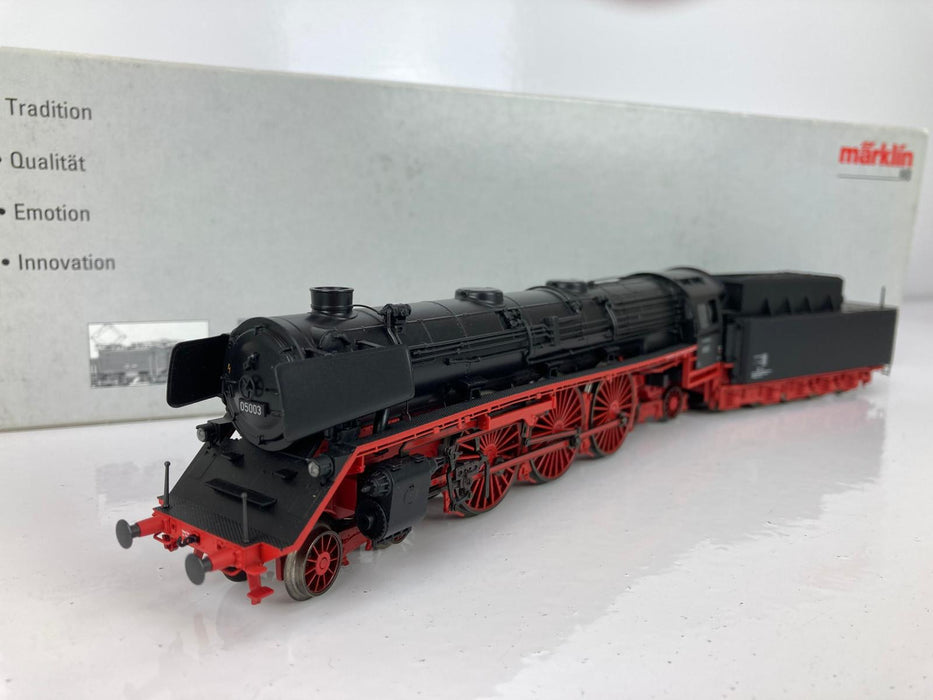
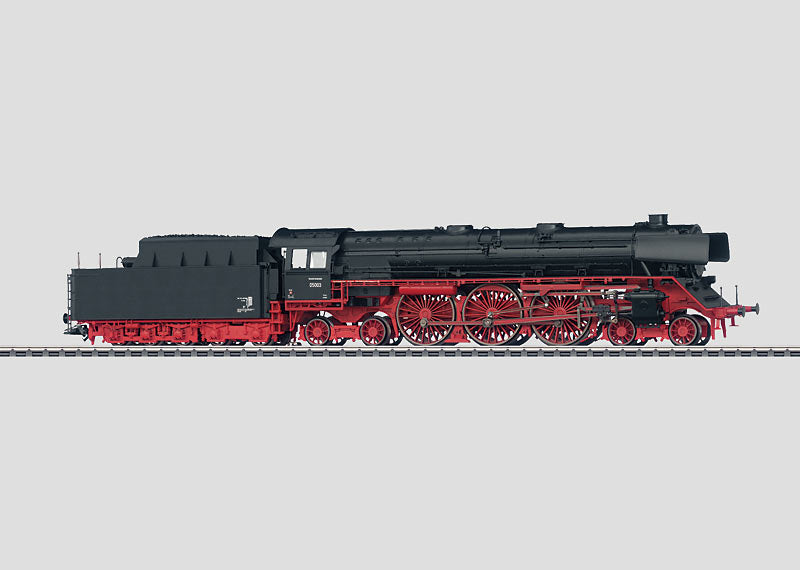
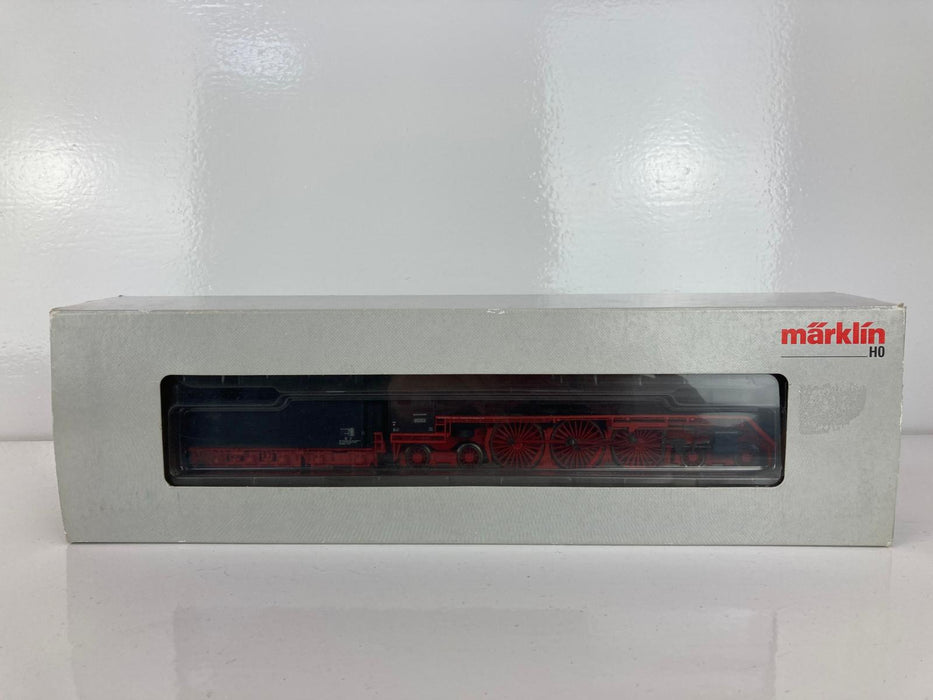
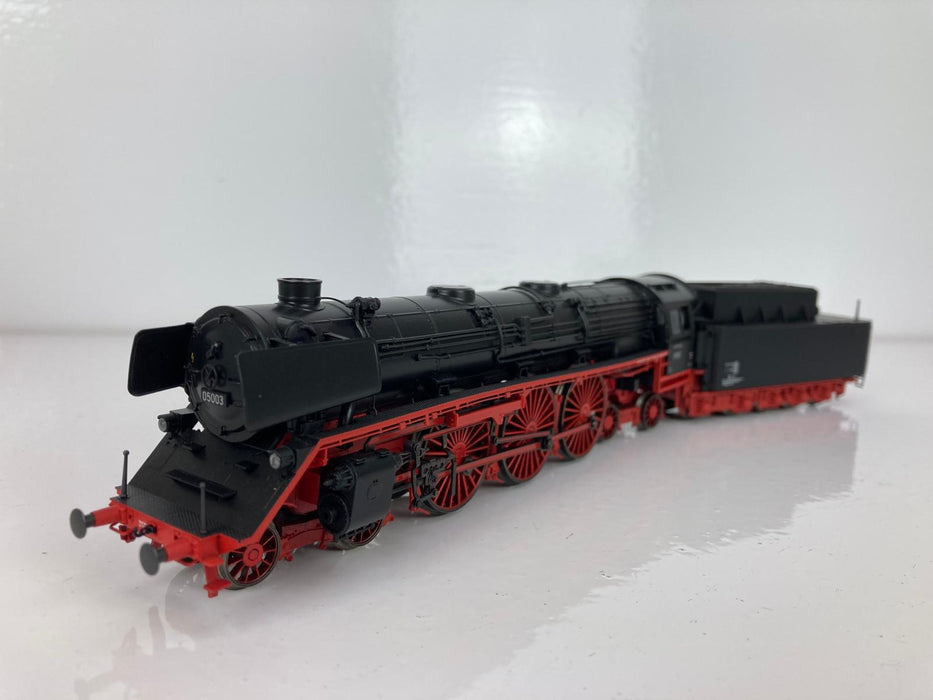
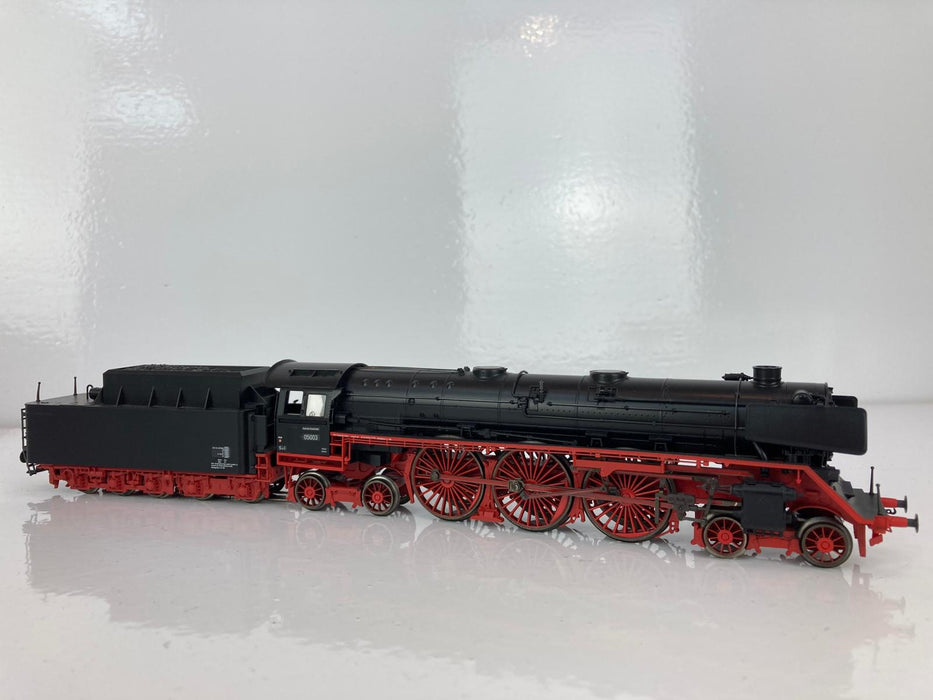
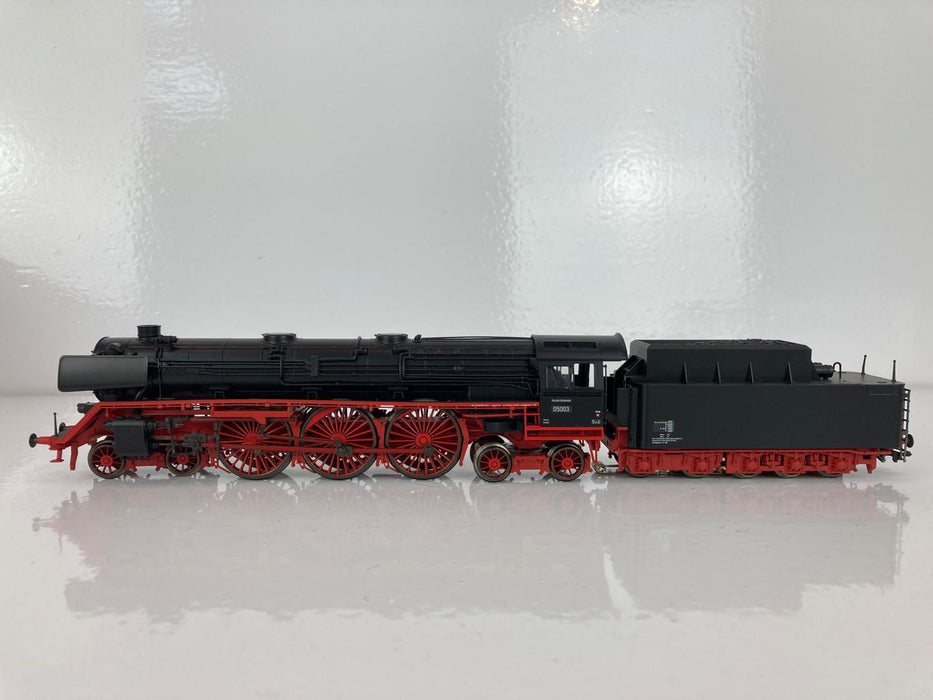
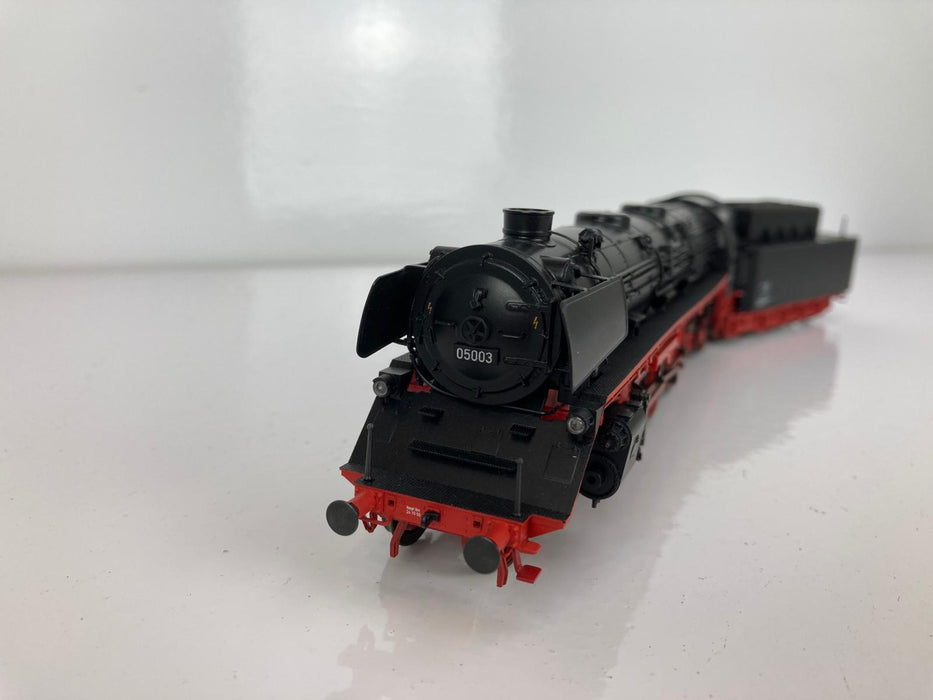
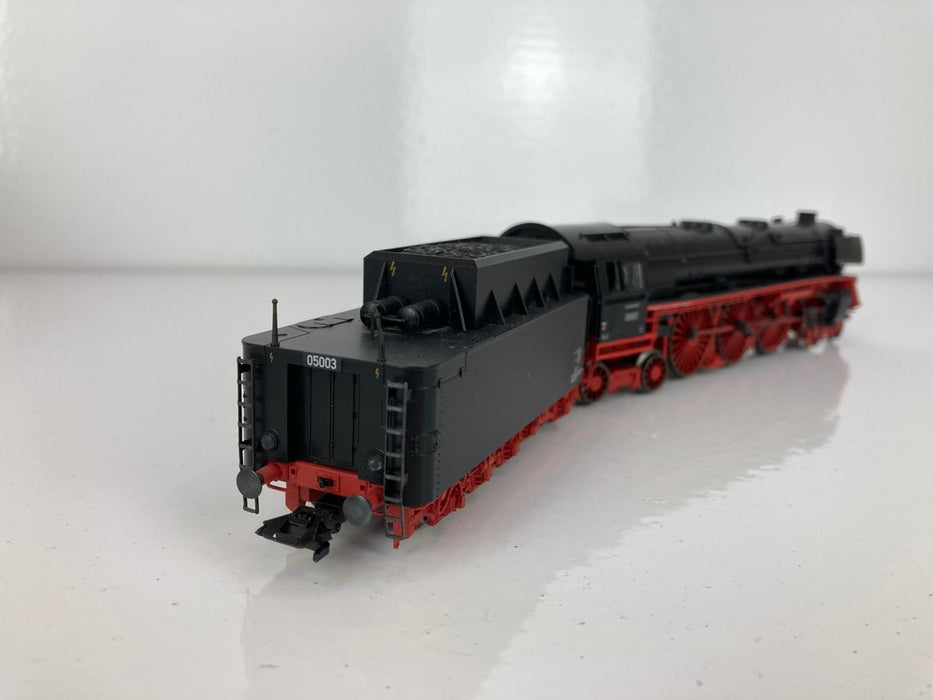
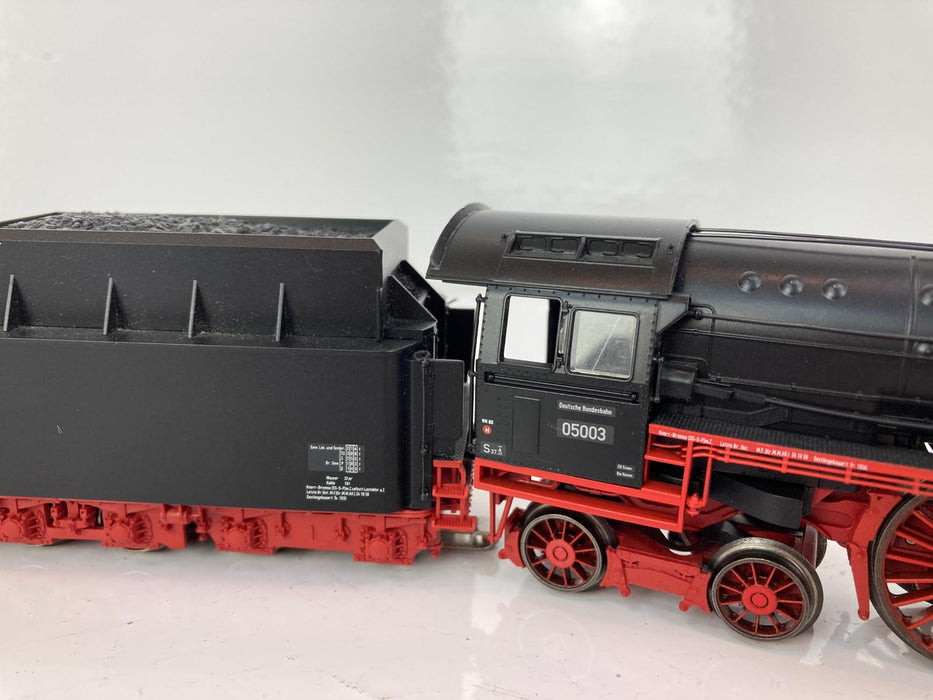
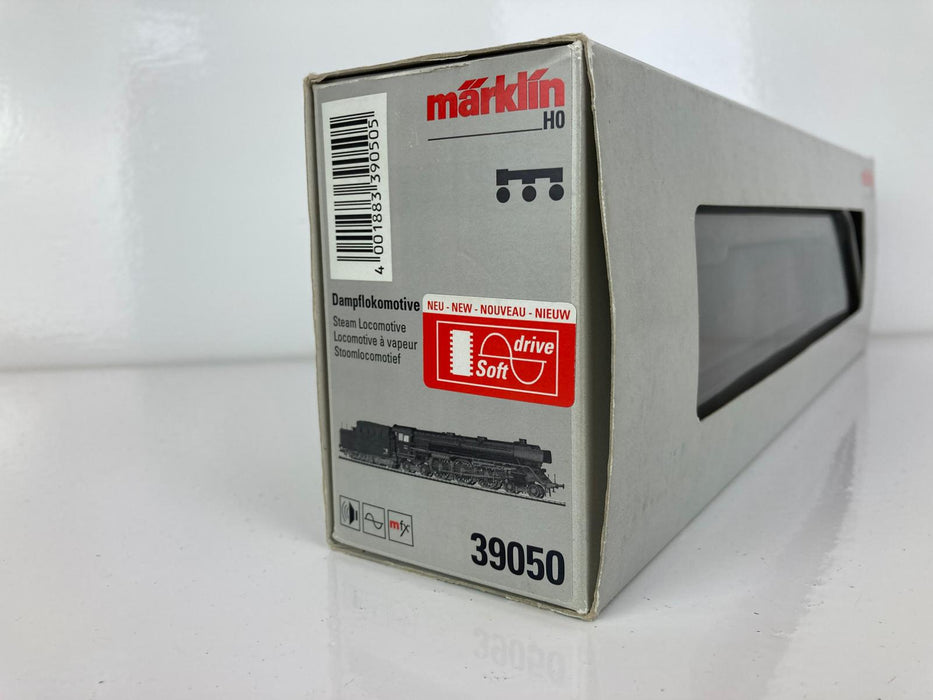
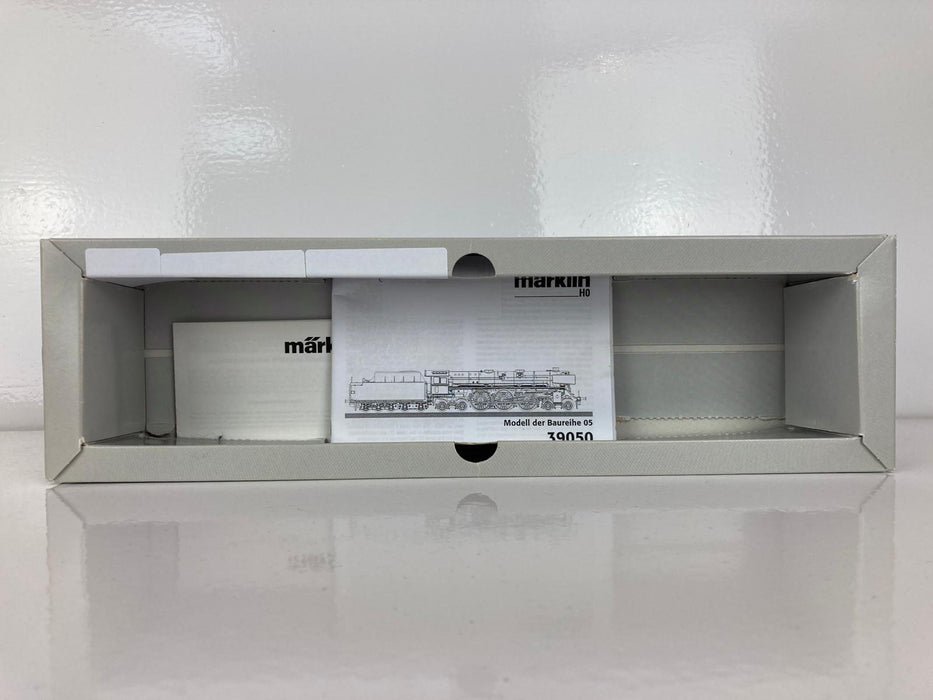
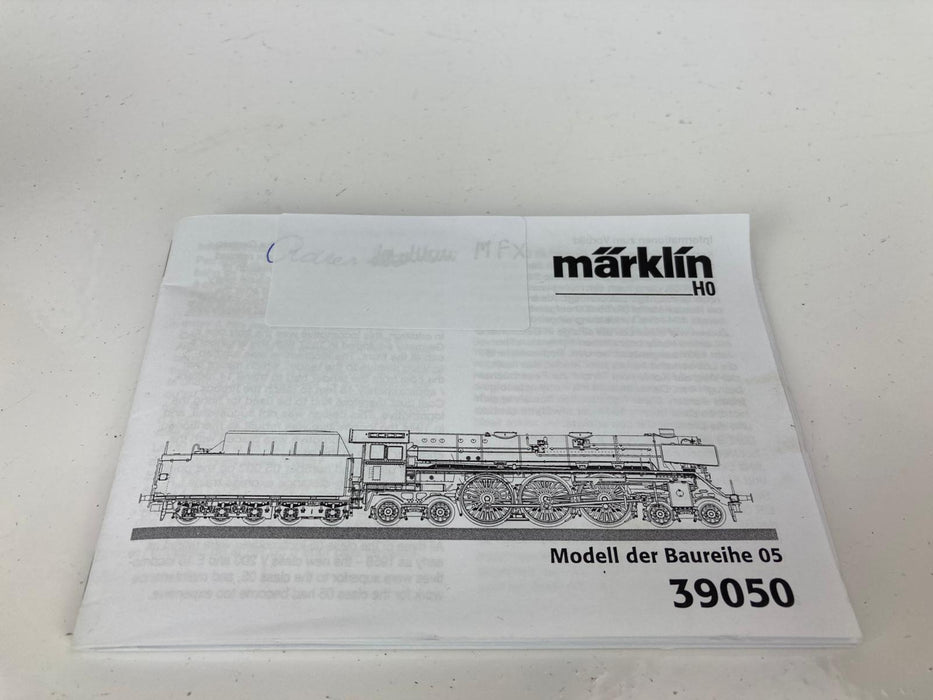
Märklin 39050 - BR 05 DB - Long Steam Locomotive with Tender - MHI
Price includes VAT
Our service
- Factory Warranty
- Fast shipping or pick up in store
- Available for all your questions
Product description
Märklin 39050 - BR 05 DB - Long Steam Locomotive with Tender - MHI
German Federal Railroad (DB) class 05 express locomotive. Operating condition of road number 05 003 from 1950 onwards without streamlining.
The locomotive 39050 is produced in a one-time series only for Insider members
Condition: As new – Complete in original packaging with manual.
- New development.
- Locomotive and tender mainly made of metal.
- High-efficiency Softdrive Sinus drive in compact design.
- Digital decoder mfx and many sound functions.
Model: The locomotive has an mfx digital decoder, controlled high-efficiency Softdrive Sine propulsion, and a sound generator with numerous functions. It features a low-maintenance, compact motor built into the locomotive's boiler. 3 axles powered, traction tires. The headlights are maintenance-free, warm white LEDs. A 7226 smoke generator can be retrofitted. The headlights and smoke generator contact will work in conventional operation and can be controlled digitally. The tender is constructed of metal. There is a permanent close coupling between the locomotive and tender, and an NEM pocket with a close coupler is located at the rear. The piston rod protection sleeve is attachable.
Minimum drivable curve radius 360 mm.
Length over buffers 30.7 cm.
Please note: All our models are carefully tested before being offered for sale.
About the locomotive:
Series 05: High flights on rails. In 1926, the German Lufthansa was founded, establishing a new carrier for all of Germany. Five years later, the Ju 52, powerful and reliable airliners were available, serving a growing route network. The Deutsche Reichsbahn recognized the emerging competition and attempted to counteract it. In consultation with the railway industry, new concepts were developed, such as "Flying Trains" on selected high-speed main lines. The dominance of steam traction was not challenged; rather, the Reichsbahn demanded a new generation of standard-design locomotives for long-distance service at 175 km/h (109 mph). The physical limits of the classic high-speed steam locomotive were almost reached with the Series 01. With a previously available continuous power output of approximately 2,500 hp, new technologies had to be developed for higher speeds: three-cylinder driving gear with increased boiler pressure. Large driving wheels with a diameter of 2.30 m (7.5 ft). A chassis similar to the American "Hudson" locomotives with a 2'C 2' wheel arrangement. Aerodynamics from aircraft construction as a modern design element for rail vehicles. Parallel to a similar initiative by Henschel (series 61), Borsig presented two giants in 1935 that combined modern construction and effective design: the 05 001 and the 05 002 with fully enclosed streamlining. Both machines masterfully met the requirements and far exceeded them. In 1936, test runs with passengers reached speeds of over 200 km/h – a record that other national railway companies attempted to match. At the time, the speed of the flying competition might have seemed to be catching up. Indeed, for almost 30 years, the record seemed like the magic limit for passenger trains. Only the DB's E 03 seriously challenged this speed, thus making today's express trains tangible. The successor 05 003 was intended to be even more innovative: its cab was modeled on the American "Cab Forward" locomotives. The direct, smoke-free view of the track was intended to improve safety at high speeds, and the aerodynamics were theoretically further improved. However, because the boiler now pointed its smokebox toward the tender, the forward firebox could not be refilled with regular lump coal. The solution was carbon firing with mechanical-pneumatic transport along the entire length of the boiler. In 1937, test runs began—and the difficulties with this daring design arose. On the "fuel" transport path of over 14 meters, quality, weather conditions, and running conditions manifested themselves in unpredictable ways. Adequate metering and continuous combustion were virtually impossible to guarantee. Up until the final test runs, the engine proved unable to meet the expected peak performance in operational use. In 1944, the Reichsbahn surrendered: road number 05 003 was converted into a standard locomotive—coal-fired and completely devoid of cladding. At this time, every locomotive was used, the showpieces serving as fast workhorses. All three express locomotives reached the end of the war in good operating condition and were transferred to the Deutsche Bundesbahn in 1950. Because no new high-performance locomotives for long-distance service were expected in the foreseeable future, they were not abandoned like other "splinter series" but modernized. Meanwhile, all streamlined locomotives had become standard locomotives, with economical operating speeds more important than spectacular maximum speeds. The road number 05s were equipped with Witte smoke deflectors and Indusi engines, making them well-equipped for 175 km/h. However, initially, the maximum speed of 130 km/h still applied to all trains on the DB. In this purely functional form, the locomotives ultimately represent the pinnacle of the development of standard-design locomotives and, at the same time, the crowning achievement. Until 1957, the 05 series was the absolute star of German long-distance service – only the E 19 could follow. Only the new construction programs with the V 200 and the E 10, and the ongoing electrification of the route network, caused significant damage to the 05, and this time the DB showed no mercy. All three were decommissioned in 1958 and were scheduled for scrapping in 1961 – but one was preserved. The Nuremberg Transport Museum showed historical interest in the 05 001. The original livery was almost completely restored in the workshops, and the red livery still fit. Since then, the locomotive has been kept operational and has its place in the main building of the DB Museum, where it was spared from the disastrous fire of October 17, 2005. The 05 003, with its eventful history, also lives on today: as a Märklin model in 1:87 scale. Even in this scale, the striking silhouette and impressive technology have a powerful and harmonious effect. A timeless and incomparable locomotive, whose exact reproduction is being presented for the first time as a high-tech model. Produced for Märklin Insider members.
Country
Duitsland
Shipping 📦
We strive to ship orders placed before 5:00 PM the same day. Orders placed after that time are usually shipped the next business day. We ship our packages with PostNL as standard and we offer multiple options. Pick-up is of course also possible in our store in Noordwijk. Please indicate this on the checkout page before payment and we will prepare your order as soon as possible.